
ZUB Esther
Hygrothermal simulation for the practical verification of moisture protection in construction
Dynamic moisture protection verification according to DIN 4108-3 – fast, practical and scientifically sound.

ZUB Esther enables the hygrothermal simulation of heat and moisture transport in building components and supports planners in reliably assessing the moisture behavior of structures in new construction and renovation projects.
The calculations are based on the proven WUFI® engine from the Fraunhofer Institute for Building Physics (IBP) and are specifically optimized for practical use in moisture protection verification according to DIN 4108-3.
This allows critical moisture situations such as condensation, mold risks, or moisture penetration of building components to be identified early and avoided during the planning phase.
ZUB Esther 30 Days free test
Highlights
Practice-optimized input
Many boundary conditions are set automatically. This significantly reduces the input effort and prevents typical input errors. In many cases, a few key details regarding the component structure, usage, airtightness, surface conditions, and climate region are sufficient for a calculation.
Proven scientific calculation engine
Calculations are performed using the WUFI® calculation engine from the Fraunhofer Institute for Building Physics IBP. This calculation engine enables a realistic simulation of heat and moisture transport processes, taking dynamic boundary conditions into account.
Efficient moisture protection verification
ZUB Esther was consistently developed for practical construction use. Hygrothermal simulations can thus be carried out quickly and economically – especially for planning offices, energy consultants, and building physicists who regularly perform moisture protection assessments according to DIN 4108-3.
Excellent traceability of results
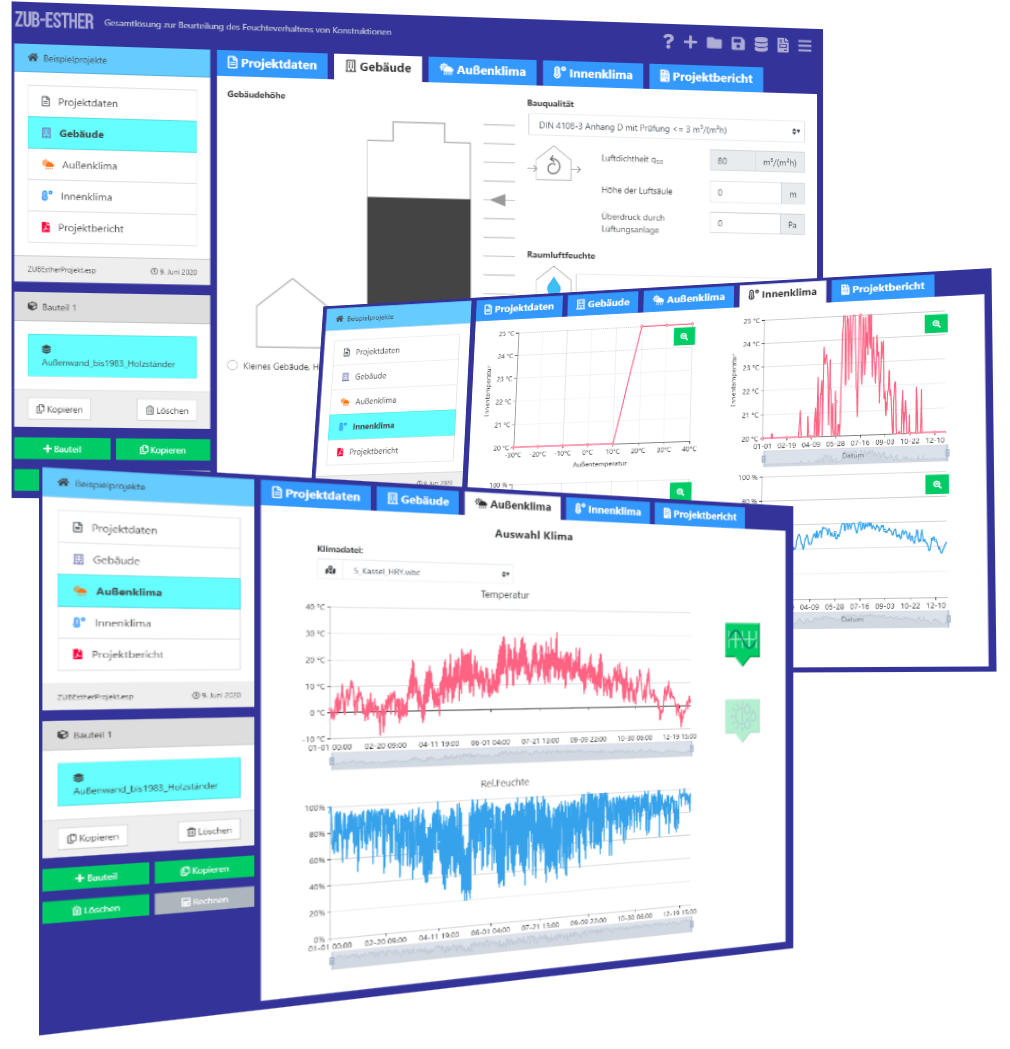
The simulation results are prepared graphically. Temperature profiles, moisture profiles, water contents, and critical limit violations can be clearly evaluated and documented.
For which tasks is ZUB Esther suitable?
ZUB Esther supports hygrothermal component simulations for typical practical construction verification and assessment cases. The software is particularly useful when simplified methods, such as the periodic balance or Glaser verification, are insufficient to reliably assess the actual moisture behavior of a design.
1. Hygrothermal Simulation of Components
ZUB Esther calculates heat and moisture transport processes in components over an extended period. In doing so, it accounts for temperature profiles, moisture content, capillary moisture transport, sorption, climatic boundary conditions, and drying processes. Hygrothermal simulation enables a significantly more realistic assessment than purely steady-state verification methods. It helps detect critical moisture developments early, optimize component layups, and evaluate long-term moisture risks. Typical questions include:
- Does the design remain permanently safe regarding moisture control?
- Can introduced or absorbed moisture dry out again?
- Are critical material moisture levels reached?
2. Dynamic Moisture Protection Verification according to DIN 4108-3 Appendix D
ZUB Esther is optimized for dynamic moisture protection verification according to DIN 4108-3 Appendix D. The software supports planners in assessing designs where a simplified verification is not permitted and a dynamic analysis is required. Its application is especially relevant for components with complex materials, multi-layer designs, renovation measures, and demanding roof or wall structures. ZUB Esther automatically sets many required boundary conditions based on the component type. This guides the verification process in a practice-oriented manner and reduces input effort.
3. Differentiation from the Periodic Balance / Glaser Verification Method
The classic periodic balance or Glaser verification is a simplified method. It primarily considers diffusion-based moisture transport under steady-state boundary conditions. Moisture storage, capillary moisture transport, solar radiation, construction moisture, driving rain, or time-varying climate conditions are either not represented or only very limitedly captured. For many standard designs, there is additionally a simplified verification via the list of verification-free designs in DIN 4108-3. For designs deviating from these or for special boundary conditions, a hygrothermal simulation is required. ZUB Esther supports exactly this dynamic analysis and helps overcome the limitations of simplified verification methods in building practice.
4. Hygrothermal Simulation with the WUFI® Calculation Engine
A key feature of ZUB Esther is the integrated WUFI® calculation engine from the Fraunhofer Institute for Building Physics IBP. In this way, ZUB Esther combines a proven scientific calculation engine with a practice-oriented user interface and a workflow aligned with moisture protection verification according to DIN 4108-3. This makes ZUB Esther particularly interesting for users who want to apply hygrothermal simulations efficiently and economically in daily planning. The software is deliberately practice-oriented and reduces many inputs that would otherwise have to be determined manually in more comprehensive simulation environments.
5. Interior Insulation
Interior insulation imposes several requirements on moisture protection. Applying insulation to the indoor surface significantly changes the temperature and moisture behavior of the exterior wall. The existing wall becomes colder, which impacts intersecting walls and ceilings. Furthermore, it must be verified whether indoor moisture from the inside or driving rain from the outside affects the design. ZUB Esther supports the hygrothermal assessment of interior insulation designs and helps verify whether:
- Harmful condensation can form,
- Moisture dries out sufficiently,
- Critical material moisture levels are reached,
- Mold risks can develop,
- The planned buildup is safe in terms of moisture control.
Simulation is particularly relevant for interior insulation with pronounced sorptive and capillary properties on single-leaf exterior walls when simplified verification is no longer sufficient.
6. Insulated, Unventilated Wooden Roof Structures
Wooden components react sensitively to elevated moisture content. For insulated, unventilated wooden roof structures, a dynamic simulation can be required, especially when metal roof coverings or waterproofing membranes are placed on sheathing or boarding without rear ventilation of the waterproofing or decking substrate. ZUB Esther supports the assessment of such roof designs by simulating the moisture development in the component over an extended period. Typical questions include:
- Does the moisture content of wood or wood-based materials rise above limit values?
- Is there sufficient drying potential?
- How does the water content develop in individual layers?
In ZUB Esther 6.1, additional functions were supplemented for this purpose, including the WTA-6-8 method for calculating the pore air humidity of wood, as well as a differentiated calculation of wood moisture levels for wood-based materials according to service classes.
7. Components in Contact with the Ground
Components in contact with the ground are among the structures where simplified moisture protection assessments do not apply. ZUB Esther 6.1 includes a calculation method for components in contact with the ground in accordance with the specifications of DIN 4108-3. ZUB Esther supports planners in tracking the moisture development of such components and evaluating the design with regard to long-term moisture safety.
8. Green and Graveled Flat Roof Structures
Green and graveled flat roof structures, as well as roof structures with slab coverings or wooden gratings, can be highly demanding regarding moisture protection. The additional layers alter the boundary conditions for heating, drying, and moisture release. ZUB Esther provides special exterior climate datasets for gravel and green roof structures, allowing these roof buildups to be evaluated for practical applications. The simulation supports, among other things, the analysis of:
- Moisture accumulation in the roof structure,
- Drying potential,
- Long-term moisture development,
- Critical material moisture levels.
9. Mold Prevention and Critical Moisture Conditions
ZUB Esther supports the assessment of critical moisture conditions within the component and at boundary layers. In version 6.1, checks for boundary layer temperatures and relative humidities for mold prevention were added. This allows planners to detect moisture risks early and optimize designs purposefully. While hygrothermal simulation does not replace thermal bridge assessments of connection details, it can provide important indications of moisture-critical component states. For detailed thermal bridge assessments of connection details according to DIN 4108-2, ZUB Argos is suitable. For hygrothermal component simulation and the assessment of the moisture behavior of layers and materials, ZUB Esther is the appropriate tool.
Key Features at a Glance
- Proven WUFI® calculation engine
- Database of dynamic material properties
- Climate datasets for different regions
- Special outdoor climate datasets for gravel-covered and green roof constructions
- Automatic assignment of many boundary conditions based on the building component type
- Calculation of temperature profiles and moisture content in building components
- Evaluation of drying processes
- Consideration of the dynamic moisture properties of building materials
- Graphical visualization of temperature and moisture profiles
- Clear evaluation results and reports
- Import function for WUFI® XML material datasets
- Comprehensive reporting functions with export options
Version highlights
New in Version 6.1
ZUB Esther 6.1 extends the software's capabilities with new features for practical moisture protection assessments in building design. New features include:
- Calculation method for below-grade building components in accordance with DIN 4108-3
- WTA 6-8 method for calculating pore humidity in wood
- Advanced calculation of wood moisture content for wood-based materials in Service Classes 1–3
- Assessment to prevent frost damage
- Evaluation of interface temperatures and relative humidity for mold prevention
Typical use cases
ZUB Esther is used for:
- Dynamic moisture protection assessments in accordance with DIN 4108-3, Annex D
- Hygrothermal simulation of building components
- Evaluation of interior insulation systems
- Analysis of insulated, unventilated timber roof constructions
- Assessment of below-grade building components
- Analysis of green roofs and gravel-covered flat roof constructions
- Verification of critical wood moisture content and pore humidity
- Assessment of mold growth risks caused by critical moisture conditions
- Evaluation of refurbishment and renovation measures in existing buildings
The software is primarily used by:
- Energy consultants
- Building physicists
- Architects
- Engineering and planning firms
- Building surveyors and construction experts
User Interface


Summary
Fast verification with just a few inputs
A few inputs are typically sufficient for a calculation:
- Component structure from the integrated material database,
- Building size and usage,
- Airtightness,
- Surface conditions,
- Selection of the climate region.
As soon as the component type is defined, the software automatically sets most of the required boundary conditions. This reduces the error rate and workload. As a result, moisture-dynamic verifications can be carried out significantly faster.
Proven scientific calculation engine
The calculations are performed using the WUFI® calculation engine from the Fraunhofer Institute for Building Physics IBP. This calculation engine is scientifically validated and enables a realistic simulation of heat and moisture transport, taking dynamic climate conditions into account. Among other things, the following are considered:
- Capillary moisture transport,
- Sorption processes,
- Precipitation and weathering influences,
- Solar radiation,
- Construction moisture,
- Climatic boundary conditions.
This allows complex component designs to be evaluated for practical building applications.
Optimized for practical construction verification according to DIN 4108-3
ZUB Esther enables dynamic moisture protection verification according to DIN 4108-3 Appendix D by means of hygrothermal simulation of components. The software is suitable for:
- New buildings,
- Energy efficiency renovations,
- Residential buildings,
- Non-residential buildings with residential-like use,
- Planning and verification tasks in practical structural moisture protection.
Its use is particularly beneficial for designs where simplified methods, such as the periodic balance method or the "Glaser" verification, are insufficient, for example in:
- Interior insulation,
- Components in contact with the ground,
- Green and graveled flat roof structures,
- Insulated, unventilated wooden roof structures,
- Multi-layer components with moisture-sensitive materials.
Interpret results immediately and understandably
The simulation results are presented in clear diagrams, enabling a quick assessment of the design. ZUB Esther shows, among other things:
- Temperature profiles within the component,
- Moisture profiles of individual material layers,
- Water content over time,
- Critical limit violations.
If a permissible maximum value is exceeded, the program highlights this immediately in the graphical display. This makes it quickly apparent whether a design functions safely in terms of moisture control or needs to be adjusted.
Excellent price-performance ratio
ZUB Esther was consistently developed for the practical requirements of planners and energy consultants. Through the combination of a scientifically sound calculation engine, a practice-oriented user interface, and reduced input effort, users have a powerful simulation tool at their disposal that enables efficient and economical hygrothermal verifications. ZUB Esther is therefore a lean, practice-oriented solution for many typical tasks in hygrothermal component simulation – featuring the proven WUFI® calculation engine and a clear focus on moisture protection verification according to DIN 4108-3.
Test for free
Test ZUB Esther for 30 days with no obligation and check your designs with realistic hygrothermal simulations.
Test ZUB Esther for 30 days free of charge
Software versions

System requirements
| Operating System | Windows 10/11 |
| Processor | Dual-core 2 GHz or higher (Quad-core 3 GHz recommended) |
| Memory (RAM) | Minimum 4 GB |
| Disk Space | 500 MB per installation |
| Display Resolution | 1280 × 1024 pixels with a minimum color depth of 32-bit |